Arc Browser Shutting Down on December 22
 Software
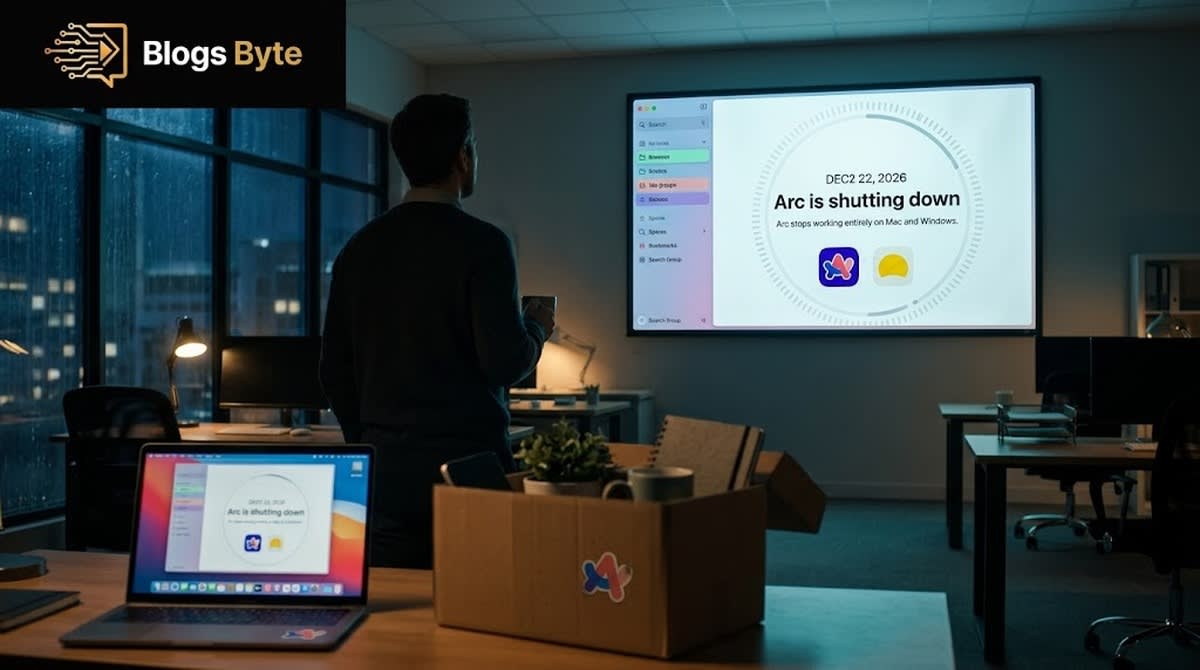
Arc browser shutting down on December 22, 2026. The dates that matter, what Dia keeps and drops, and what Arc users should sort out before the cutoff.
If you use Arc every day, you probably felt your stomach drop on Thursday. The Browser Company announced that Arc browser shutting down is now official: the app stops working on Mac and Windows on December 22, 2026. The company wants its users to move to Dia, its AI-first browser.
Anyone who builds or uses software for long enough gets this news sooner or later. A tool you built your working day around gets an end date, and somebody else picked the date. We saw the same thing earlier this month, when developers started asking is Deno dead after the Deno team joined Cloudflare. Arc's story is different in the details, but the feeling is the same.
Here are the dates, the reasons the company gave, what carries over to Dia, and what is still unclear.
Arc browser shutting down: the dates that matter
The wind-down comes in three steps, according to TechCrunch.
- Thursday, October 22: new Arc accounts can no longer be created.
- November 23: Arc Search on iOS and Android loses its AI features, including "Browse for Me." You can no longer sign in or sync tabs. The app still works as a basic local browser.
- December 22: Arc stops working entirely on Mac and Windows. Accounts are deactivated, and personal data is deleted within 30 days. Arc Search is also removed from the Google Play Store.
If you want one date to write on a calendar, make it December 22. If you use Arc Search on your phone, the earlier date, November 23, is the one that changes things first. That is the Arc browser shutdown date for the desktop app, and the mobile app starts losing features a month sooner.
Why is Arc shutting down?
The company's own reason is security. It wrote that "keeping a browser secure takes constant, dedicated work that is only increasing in the age of AI." It added that Dia "was built from the ground up to meet today's security standards, so that's where our engineering and security teams will focus moving forward."
That sentence deserves a moment. A browser is not like a note-taking app. It sits between you and almost everything you do online, so it needs security fixes all the time, and it needs them quickly. Keeping two browsers patched costs any company a lot. I read this as an honest explanation, though it is also a convenient one, because the company has been putting its effort into Dia for a while.
There is background here too. The Browser Company stopped active feature work on Arc back in 2025, and it was acquired by Atlassian for $610 million that same year, as TechCrunch reports. At the time the company admitted that early fans loved the unusual design, but a "novelty tax" and the browser's complexity held back mainstream use. Arc was loved by a devoted group, and it never quite became the mass-market Chrome alternative its makers once hoped for.
Is Arc browser dead?
Not today, and the honest answer has two halves.
Arc works right now. On Mac and Windows it keeps running until December 22. But it has been in a kind of slow fade since 2025, when new features stopped, and it now has a hard end date. So is Arc browser dead? Not yet, but the clock is running, and it will be properly gone after the 22nd.
It is the same shape as other end-of-support stories. If you have ever planned around Windows 10 extended security updates, you know the routine: things keep working for a while, and then there is a day after which the software is on its own. The difference with Arc is that this isn't just support ending. After December 22 the app itself stops, and your account goes with it.
Will Arc browser stop working after December 22?
Yes. On Mac and Windows, Arc stops working entirely on that date, accounts are deactivated, and personal data is deleted within 30 days.
That last part matters. It means the safe plan is not "wait and see." Anything you have not moved, such as passwords, bookmarks, extensions or history, should be sorted out before the cutoff, because the company says your data goes within 30 days of it. Dia can carry these over, which I cover next. If you plan to move somewhere else, do the same early and keep a copy of anything important.
Dia browser vs Arc: what carries over
TechCrunch lists what carries over from Arc to Dia, and it is more than I expected.
- Spaces become Profiles. You can still swipe between work and personal environments, now called Profiles.
- Vertical tabs stay, as an optional sidebar layout.
- Folders are renamed "Pinned Tab Groups."
- Passwords, bookmarks, extensions and history transfer to Dia.
- Arc features are free in Dia, and AI is optional.
The renaming is a small thing, but it will catch people out. Software companies love to change the labels on features that people already know. Slack did something similar when Later became To-dos. The tool is familiar, but the buttons have new names.
The company also claims Dia now beats Arc on speed, stability and security benchmarks. That is the company's own claim, and the article does not show test results, so treat it as a claim until you have tried it yourself.
On the AI side, the "optional" part matters to a lot of people. If a browser with AI built in makes you uneasy, you are not alone. It helps to understand what that AI is actually doing, and our short guide on how AI actually works is a good place to start. If you do use it, why most people use AI wrong is worth a read before you hand it your daily work.
Why can't Arc just become open source?
This was the top request on social media. TechCrunch says user reactions were largely disappointed, and many people revived calls for the company to release Arc as open source.
The company has answered this before. CEO Josh Miller said, "While we'd love to open-source Arc someday, we can't do that meaningfully without also open-sourcing ADK. And ADK is still core to our company's value." ADK is the Arc Development Kit, an internal SDK that is also the core engine behind Dia. Releasing Arc would mean giving away what powers the company's main product.
Whether you agree or not, the logic is easy to follow. A company can't hand over the engine of its main product just because fans ask nicely. Other companies make the opposite choice. Meta recently released Muse Spark Open, a large AI model anyone can download. But that was Meta choosing to release a model. Arc's makers built their browser on a core they still depend on.
So for now, the question of Arc browser open source has a clear answer: not unless the company changes its mind about ADK.
Arc browser alternatives people mention
I haven't tested these for this article, so treat this as a starting list rather than a recommendation. Dia is the obvious option, since your passwords, bookmarks, extensions and history move across and the Arc features you know are there. TechCrunch does not say which platforms Dia runs on, so check that before you plan around it.
Beyond Dia, the names that come up most for people who miss Arc's sidebar and spaces are Zen Browser, an open-source browser built on Firefox, and Vivaldi, which is known for being very customisable. Whatever you pick, look at its current features and its own site first. Comparison pages for Arc browser alternatives are often written by companies that sell a browser themselves, and they rank themselves accordingly.
And if you are weighing Dia against Arc, the real question is the one the company has already answered for you: Dia is where the company's effort goes now, and Arc's future is a date.
What this means beyond Arc
A few lessons are worth taking from this, and none of them is about browsers.
First, the things you rely on have owners, and owners change their minds. Keep your important data portable, and don't wait for the final month to move it.
Second, the AI push is reaching software that has nothing to do with chat. Browsers, note apps and operating systems are all adding AI, and they are also changing what they ask permission for. Apple recently tightened Full Disk Access on macOS so AI agents must ask clearly before reaching your files. Even the labs building the models are pulling them back from open access: OpenAI stops training on the live internet because it no longer trusts its models with it.
Third, tools that run in a browser tab and need no account have no end date to worry about. That is why we keep our free online tools simple and in the browser. You can see all of them in our guide to every free tool on Blogs Byte.
What we still don't know
- Whether Dia is available on every platform Arc ran on.
- How the migration works in practice for people with a lot of tabs, or with extensions that rely on Arc-only features.
- Whether the company will change its mind on open source before December 22.
- What happens to Arc Search users who have not moved their data by the end date.
The bottom line
Arc browser shutting down is not a surprise, but it is still a loss. It was a browser people actually loved, and it showed that a browser could look different. Now it has an end date, and the company is putting its weight behind Dia.
If you are an Arc user, do not wait. Mark December 22 on your calendar, mark November 23 if you use Arc Search on your phone, and decide where your data goes before then. After that, the app is gone, and the data goes with it.
FAQs
When is Arc browser shutting down?
Arc stops working on Mac and Windows on December 22, 2026. New accounts could no longer be created from October 22, and on November 23 Arc Search on iOS and Android loses its AI features and sign-in.
Is Arc browser dead?
Not yet. It works until December 22, but its feature development stopped in 2025 and it now has a firm end date. After that date, it stops working entirely.
Will Arc browser stop working?
Yes. On December 22 Arc stops working on Mac and Windows, accounts are deactivated, and personal data is deleted within 30 days.
What replaces Arc, and what carries over?
The Browser Company directs users to Dia. Passwords, bookmarks, extensions and history transfer to Dia. Spaces become Profiles, vertical tabs stay as an optional sidebar, and Folders are now called Pinned Tab Groups.
Will Arc become open source?
Not for now. CEO Josh Miller said the company would love to open-source Arc someday, but that it can't do so meaningfully without open-sourcing ADK, the internal SDK that also powers Dia and is still core to the company's value.
Blogs Byte explains AI, software and productivity in plain English, and builds free browser-based tools.